)
)
27 Jul 2026
DuPont and Empa Collaborate to Advance Comfort in Protective Clothing
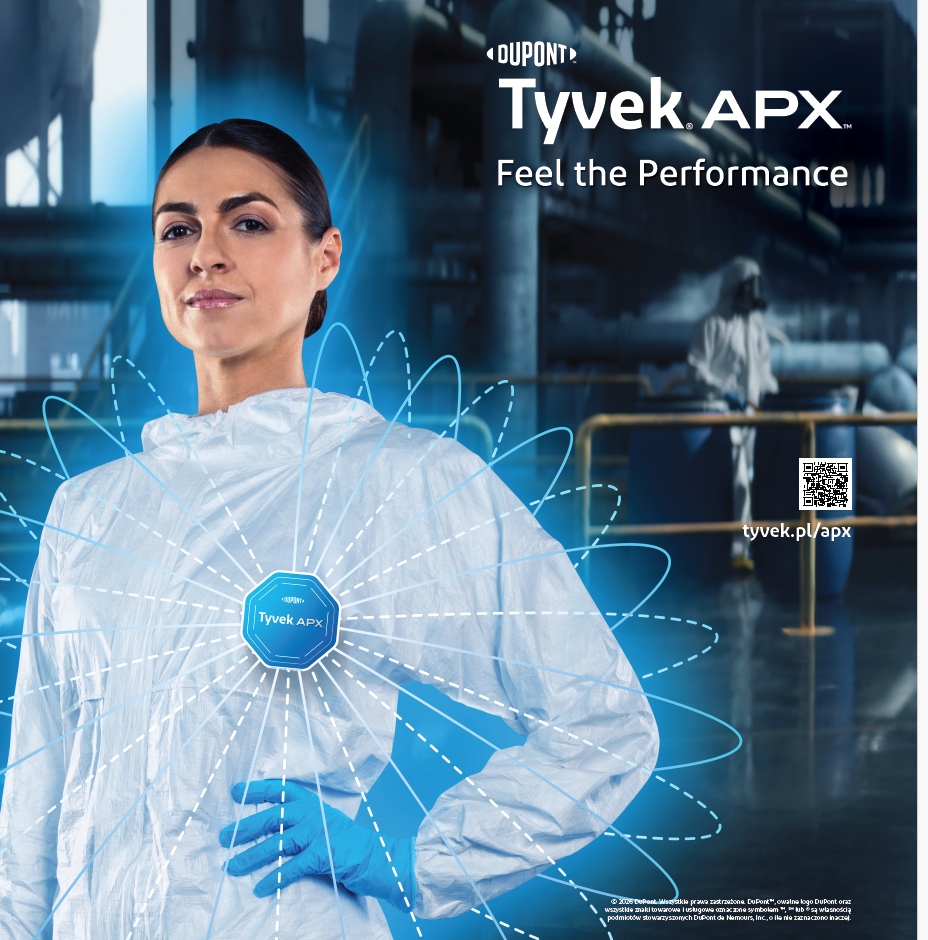
DuPont and Empa Collaborate to Advance Comfort in Protective Clothing
Independent tests prove the exceptional breathability of DuPont’s next-generation protective garments.
LUXEMBOURG, 4th December 2025 – DuPont (NYSE:DD) has announced that independent testing of its new Tyvek® APX™ fabric for personal protective equipment (PPE) has revealed exceptional breathability of the material under real-world conditions, significantly reducing perceived thermal strain and shortening recovery time relative to traditional garment options.
The collaboration with Empa, the Swiss Federal Laboratories for Materials Science and Technology, has been undertaken to evaluate the physiological impact of DuPont’s next-generation Tyvek® protective garments. The data-driven, multi-scale approach marks a significant milestone in DuPont’s commitment to innovation in PPE, with a focus on enhancing wearer comfort without compromising safety.
The study leveraged Empa’s advanced human thermoregulation model and controlled environment trials to assess thermal strain, sweat rate, skin temperature, and overall comfort perception, which was then augmented by human trials with biometric monitoring to validate the simulation data. The research evaluated the breathability of Tyvek® APX™ protective clothing under real-world working conditions, including high ambient temperatures, controlled humidity, and medium and intense activity levels.
Simulation using Empa’s thermoregulation model predicted that Tyvek® APX™ fabric allows for a slower rise in core body and skin temperature. This effect helps reduce heat strain and perceived thermal strain and shortens recovery time during high temperatures and strenuous activities, compared to traditional garment options, including daily outfits.
Human trials involving physiological data from individuals equipped with biometric sensors have validated the data obtained from these simulations. The results confirmed that the enhanced breathability of Tyvek® APX™ garments significantly reduces heat load compared to other protective clothing. This reduction in heat strain is evidenced by lower core body temperature, reduced skin temperature, and diminished cardiovascular and respiratory responses.
“DuPont is committed to embracing scientific, data-driven methodologies that go beyond traditional means of PPE testing,” says Aldjia Begriche, Global Application Development
Leader, DuPont Personal Protection. “The scientific collaboration with Empa provided a rigorous simulated dataset that was then verified by human trials with biometric monitoring of real people using metrics like skin temperature, core body temperature, heart rate, breathing rate, and sweat loss. The results demonstrated the superior breathability performance of Tyvek® APX™ protective clothing, enhancing wearer comfort without compromising PPE safety.”
Simon Annaheim, Scientific Group Leader, Biomimetic Membranes and Textiles, from Empa, comments: “The key objectives of the physiological study are to measure biometrics in order to evaluate the interactions between protective clothing and human responses, particularly comfort. Comfort can be evaluated based on fabric or garment data, but adding the measurement of biometric data allows for a more comprehensive view of protective clothing in real-world applications.”
Phase three of the strategic collaboration between DuPont and Empa is now underway. This activity includes conducting expanded human trials with increased participant diversity to reinforce and generalize findings.
Aldjia Begriche from DuPont, adds: “Empa has world-renowned expertise in materials science and technology, and we are delighted to continue our collaboration in pursuit of the PPE innovations that improve wearability to maximize worker safety.”
For more details, please visit: tyvek.co.uk/apx
About DuPont
DuPont (NYSE: DD) is a global innovation leader, providing advanced solutions that help transform industries and improve everyday life across our key markets of healthcare, water, construction, and transportation. More information about the company, its businesses and solutions can be found at www.dupont.com. Investors can access information included on the Investor Relations section of the website at investors.dupont.com.
# # #
This information is based upon technical data that DuPont believes to be reliable. It is subject to revision as additional knowledge and experience become available. It is the user’s responsibility to determine the level of toxicity and the proper personal protective equipment needed. The information set forth herein reflects laboratory performance of fabrics, not complete garments, under controlled conditions. This information is intended for use by persons having the technical expertise to undertake evaluation under their own specific end-use conditions, at their own discretion and risk. Anyone intending to use this information should first check that the garment selected is suitable for the intended use. The end-user should discontinue use of the garment if fabric becomes torn, worn or punctured, to avoid potential chemical exposure. Since conditions of use are beyond our control, DUPONT DE NEMOURS, INC. AND ITS AFFILIATES MAKE NO WARRANTIES, EXPRESSED OR IMPLIED, INCLUDING BUT NOT LIMITED TO WARRANTIES OF MERCHANTABILITY OR FITNESS FOR A PARTICULAR PURPOSE AND ASSUME NO LIABILITY IN CONNECTION WITH ANY USE OF THESE PRODUCTS AND THIS INFORMATION. This information is not intended as a license to operate under or a recommendation to infringe any trademark, patent or technical information of DuPont or other persons covering any material or its use.
DuPont™, the DuPont Oval Logo, and all trademarks and service marks denoted with ™, ℠ or ® are owned by affiliates of DuPont de Nemours, Inc. unless otherwise noted.
)
)
)
)
)
)
)
)
)
)
)
)
)
)
)
)
)
)
)

)

)
)
)
)
)
)

)
)
)
)
)
)
)

)
)
)
)
)
)
)
)
)
)

)
)
)
)