)
)
HardLine™ Silencers
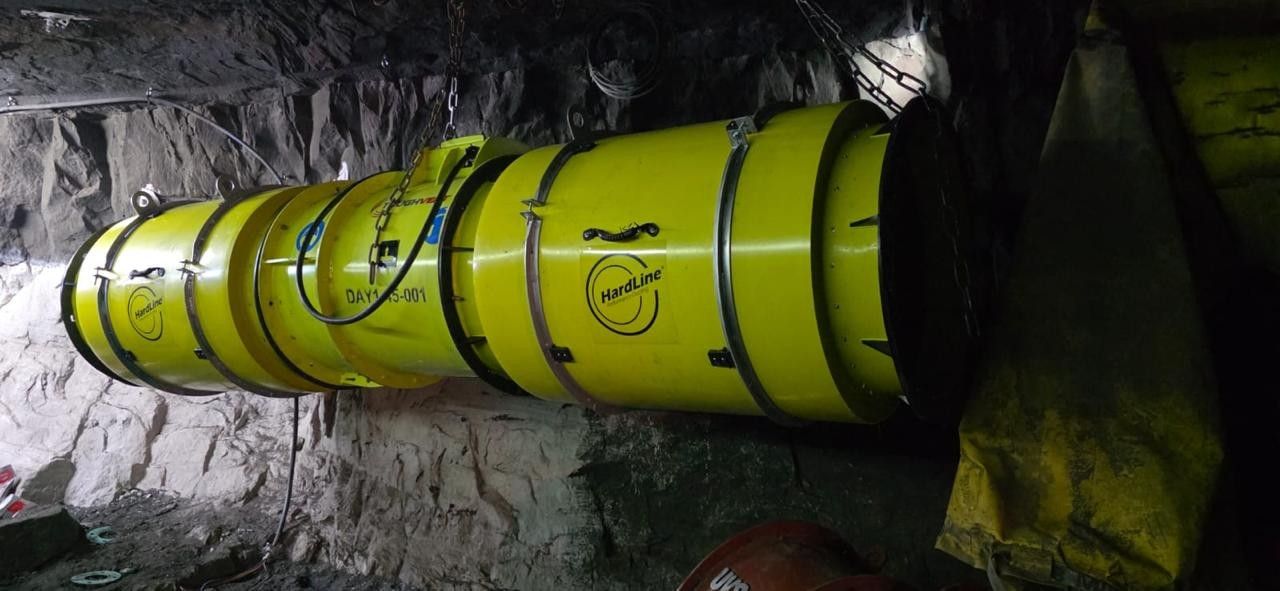
Noise generated by auxiliary ventilation fans remains one of the most significant occupational hazards in underground mining environments, where sustained exposure to high sound pressure levels can lead to permanent hearing damage, reduced worker concentration, and increased safety risks. Field measurements presented in the technical study show that baseline fan noise levels frequently exceed 95 dB(A) at operator positions well above the commonly accepted 85 dB(A) exposure threshold.
To address this challenge, the HardLine™ silencer has been developed as an advanced, integrated acoustic solution that combines absorptive attenuation, structural damping, and aerodynamic optimization. The system represents a significant evolution beyond conventional steel silencers, delivering improved performance while reducing weight, installation complexity, and lifecycle costs.
Engineering Principles Behind HardLine™
Broadband Noise Generation in
Fans
Auxiliary ventilation fans
generate broadband noise across 16 Hz to 16 kHz, driven by aerodynamic
turbulence, blade-passing interactions, and mechanical vibration.
- Dominant energy typically occurs in the 250 Hz to 2000 Hz range, where human hearing sensitivity is highest.
- Low-frequency components (<125 Hz) travel further and are harder to attenuate, especially in confined underground environments.
Effective silencer design must therefore
address both broadband and frequency-specific noise without disrupting airflow.
Absorptive Acoustic Attenuation
The HardLine™ silencer operates primarily as an
absorptive acoustic device, dissipating sound energy through porous materials.
- Acoustic energy is reduced through viscous and thermal losses inside the material structure.
- Performance is governed by acoustic impedance matching, ensuring minimal reflection and maximum absorption.
- The system achieves high absorption efficiency particularly in mid-to-high frequency bands, where conventional silencers are most effective.
Insertion loss values exceeding 40 dB under controlled conditions demonstrate the capability for substantial acoustic energy reduction.
Structural Damping and Secondary Noise Control
A key innovation of the HardLine™ system is its
RigiFlex™ FR polymer casing, which introduces structural damping.
- Reduces vibration transmission from the fan and ducting
- Limits secondary noise radiation from vibrating structures
- Improves overall acoustic stability
This dual-function approach ensures that noise
is not only absorbed but also prevented from re-radiating through the silencer
structure.
Aerodynamic Optimization
In addition to acoustic design, the system
incorporates flow-optimized geometry to maintain ventilation efficiency.
- Smooth internal surfaces reduce turbulence and flow separation
- Minimize pressure losses typically associated with silencers
- Supports integration with inlet airflow control systems (IAC)
This is critical, as fan noise generation is
highly sensitive to velocity proportional to approximately the eighth power of
airflow velocity, making turbulence control essential.
Design and Construction
The HardLine™ silencer features a multi-layer,
modular construction:
- RigiFlex™ FR polymer casing – lightweight, corrosion-resistant, vibration-damping
- Perforated steel liner – structural support and optimal acoustic coupling
- Acoustic insulation layers – engineered for wide-band absorption
Key Features
- <50% weight of conventional steel silencers
- Corrosion-resistant materials for harsh mining environments
- Modular design for flexible installation and maintenance
- Compatible with fan inlet and outlet configurations
Performance Validation
Laboratory Results
Controlled testing demonstrated:
- Broadband attenuation >40 dB
- Significant reduction in mid-frequency noise (500–2000 Hz)
- Overall noise reduction from ~110 dB(A) to <88 dB(A)
Field Results
Real-world underground testing confirmed:
- Noise reduction from 97.2 dB(A) to 92.1 dB(A)
- Average attenuation of 5–6 dB(A) (equivalent to ~68% energy reduction)
While lower than laboratory performance, these results reflect realistic environmental conditions such as reflections and equipment interactions and still deliver meaningful compliance improvements and exposure reduction.
Frequency-Dependent Performance
The study highlights that attenuation varies
across frequencies:
- High Performance: 500 Hz – 2000 Hz (primary perceived noise range)
- Moderate Performance: 63 Hz – 125 Hz (low-frequency range)
This behavior aligns with acoustic theory,
where absorptive systems excel at higher frequencies, while low-frequency
attenuation may benefit from resonance-based enhancements such as Helmholtz
tuning.
Practical Benefits
The HardLine™ silencer delivers measurable
advantages in both performance and operational efficiency:
Acoustic Benefits
- Significant broadband noise reduction
- Improved worker safety and compliance with exposure limits
- Reduced tonal noise components, including blade pass frequency
Operational Benefits
- Lower installation and transport costs due to reduced weight
- Extended service life through corrosion resistance
- Minimal impact on ventilation airflow performance
System-Level Integration
- Compatible with existing ventilation systems
- Supports custom configurations tailored to site conditions
- Can be combined with other interventions such as duct lagging and fan relocation
Conclusion
The HardLine™ silencer represents a validated,
next-generation approach to industrial noise control, integrating:
- Absorptive acoustic technology
- Structural vibration damping
- Aerodynamic flow optimization
The combination of these mechanisms enables
stable, efficient broadband attenuation while maintaining ventilation
performance, an essential requirement in demanding applications such as
underground mining.
Backed by both laboratory and field validation, the system demonstrates that effective noise mitigation is best achieved through a holistic, system-level design approach, delivering improved occupational health outcomes without compromising operational efficiency.
)
)
)
)
)
)
)
)
)
)
)
)
)
)
)
)
)
)
)

)

)
)
)
)
)
)

)
)
)
)
)
)
)

)
)
)
)
)
)
)
)
)
)

)
)
)
)