)
)
MASPRO: When Does Repeat Component Replacement Signal a Reliability Problem?
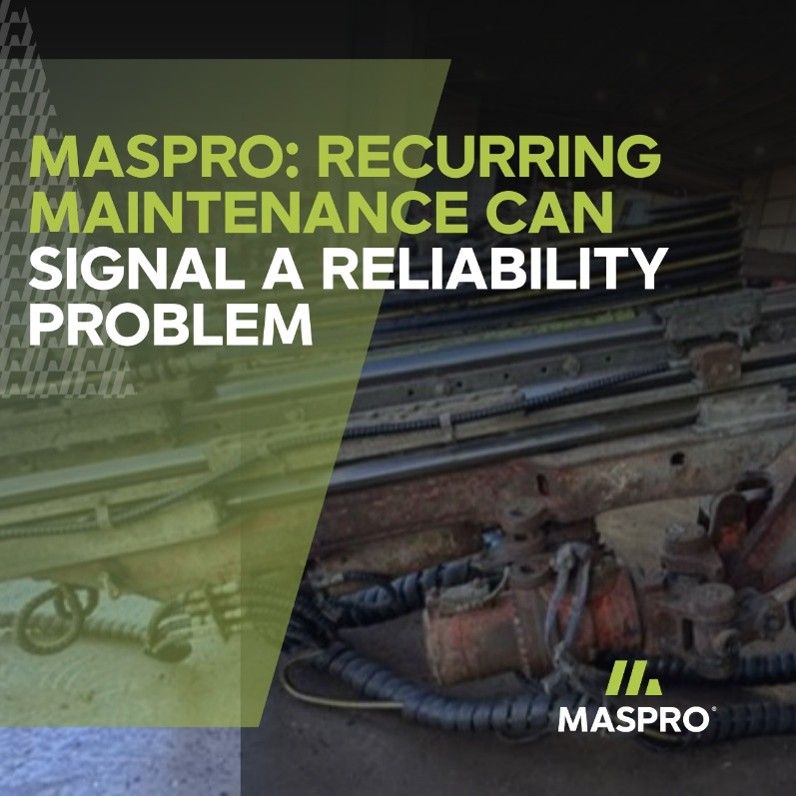
A MASPRO case
study involving feed rail ropes fitted to three Sandvik DD421 underground
development drills shows the value of that approach. The ropes control drill
positioning and transmit hydraulic feed force under high load, vibration and
abrasive conditions, and were being replaced frequently, adding maintenance
workload and manual handling exposure in a confined environment.
MASPRO investigated
the application and trialled a redesigned rope-end configuration. The trial
also evaluated changes to rope construction and materials across three
development jumbos, with all upgrades integrated into existing maintenance schedules
without operational disruption.
Over 12
months, consumption of the 12 mm feed rope fell from 188 units to 98, a
reduction of 48%, while spend fell by 73%. Consumption of a second rope
used in the same application decreased from 76 units to 36, approximately 53%,
with spend also decreasing by 74%. Fewer rope changes also meant fewer
maintenance interventions, reducing the frequency of manual-handling exposure
associated with replacement activities.
The case
points to a broader principle: recurring component consumption is evidence
about how an application performs under its actual duty cycle. Increasing
spare holdings or shortening replacement intervals may improve maintenance
preparedness, but neither changes the underlying rate of consumption. When
replacement becomes recurrent, the more valuable question is whether the
application, component design or operating conditions can be engineered
differently.
Experience across diverse mining operations
gives MASPRO perspective on what component performance is achievable in a given
application, and where recurring maintenance patterns may indicate an
opportunity for improvement. This is where MASPRO’s role extends beyond
component supply: applying engineering, application knowledge and field
experience to identify where reliability can be improved at its source.
Redefining Reliability with MASPRO
MASPRO is an
Australian-owned engineering and manufacturing company specialising in
precision-engineered aftermarket components for underground and surface
hard-rock mining equipment.
For MASPRO,
Redefining Reliability means looking closely at the maintenance patterns
that become accepted over time and asking whether engineering can change them.
The feed rope case is one example of how field experience, application
knowledge and manufacturing capability come together to improve performance
under real mining conditions.
MASPRO will
bring this perspective to Electra Mining Africa 2026, where the team will be
available to discuss recurring maintenance challenges and the role engineering
can play in improving reliability across underground and surface mining
applications.
Visitors can
meet MASPRO in Hall 3, Australian Pavilion, Stand D15-B.
Media Contact
MASPRO | Marketing
Team
marketing@maspro.com.au
Performance
note: Results relate to the operating conditions documented in this case study.
Performance outcomes may vary depending on operating conditions and
application. Organisations should assess applicability to their specific
environment.
MASPRO® is a
registered trademark of its respective owner. Sandvik® is a registered trademark
of Sandvik AB. MASPRO is not affiliated with, endorsed by, or authorised by
Sandvik AB. All references to third-party equipment are for compatibility
identification purposes only.
)
)
)
)
)
)
)
)
)
)
)
)
)
)
)
)
)
)
)

)

)
)
)
)
)
)

)
)
)
)
)
)
)

)
)
)
)
)
)
)
)
)
)

)
)
)
)