)
)
One View of the Value Chain
produces roughly 3,6 million tonnes of ore a year across three shafts — Nchwaning II, Nchwaning III and
Gloria. Until 2021, each shaft ran its own control rooms, its own operating philosophy and its own view of
production. Oculus Operational Innovations designed, engineered and delivered the Integrated Remote
Operations Centre (iROC): a single, purpose-built facility from which 21 operators oversee the entire value
chain — from the face underground to load-out — on a horseshoe video wall of 84 display panels. The
installation set two industry benchmarks: the longest continuous TBC SmartTrac operator console built to
date, and the largest SDVoE AV-over-IP video wall deployed in an industrial environment. More important
than the records is the operational shift it enabled: from reactive, shaft-by-shaft responses to proactive,
whole-of-mine decision-making from one central point.
THE CHALLENGE: A WORLD-CLASS MINE, MANAGED IN SILOS
BRMO sits in the Kalahari, about 80 km north-west of Kuruman — a remote, harsh environment where every
hour of coordinated production counts. The operation had grown into a highly decentralised structure:
each shaft independently monitored its mining, processing and essential services through separate control
rooms drawing on separate SCADA, OMI, CCTV and historian systems. No single person could see the
value chain end to end. Deviations were detected where they occurred, not where they mattered, and
coordination across shafts relied on phone calls between rooms. BRMO’s leadership, supported by ARM
project engineering, set out a clear intent: consolidate monitoring and control of all mining activities into
one central facility, with the flexibility to absorb future expansion.
THE BRIEF: ONE CONTRACTOR, EVERY DISCIPLINE
A control room of this scale is not an AV project, a furniture project or an IT project — it is all of these at
once, and the risk lives in the interfaces between them. Under contract AMM/iROC/21/0017 (iROC
equipping and furnishing, supply and installation), BRMO appointed Oculus as the single point of
accountability for the design, supply and integration management of the full fit-out: operator consoles,
the video wall and its signal backbone, ergonomics, lighting interfaces and the coordination of multiple
specialist vendors into one working facility — delivered within scope and cost, on an operating mine site,
through 2021 and 2022.
THE SOLUTION: THE IROC
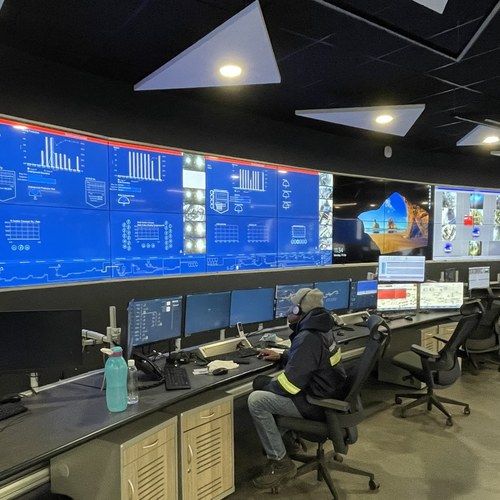
At the heart of the iROC is a horseshoe-shaped operations floor: 21 operator stations wrapped by a
continuous video wall of 84 main display panels (49-inch class), with a further 84 operator displays (24-inch)
at the desks. Each station is allocated four wall panels, centrally aligned with the operator’s console — the
wall is not a passive billboard but a direct extension of every workstation, with full drill-down and
operational functionality. The layout maps the mine’s functional locations onto the floor: essential services,
mining and processing for each of the three shafts, surface ore transport, product stockyard and load-
out, plus supervisory capacity.
ENGINEERING THE BACKBONE
Any source, any screen, instantly — that was the design requirement for the visual layer. Oculus specified
an SDVoE AV-over-IP architecture managed through VuWall’s TRx platform, combining video wall control,
AV distribution and KVM management on standard network infrastructure. The result is genuine flexibility:
operators can extend, switch and composite real-time signals from any of the mine’s systems to any panel
on the wall or any desk, without matrix switchers or fixed signal paths. The architecture scales by adding
endpoints, which protects BRMO’s investment as the operation expands. Redundancy was engineered in
deliberately: every functional application can be opened on any of the 21 stations, and the wall follows
— a failed desk never means a blind spot on the value chain.
DESIGNED AROUND THE OPERATOR
Technology alone does not change how a mine is run; people do. The iROC applies a strict situational-
awareness philosophy: calm, low-contrast graphics when the process runs normally, so that colour and
motion are reserved for the moments that demand attention. Alarming on the wall is deliberately sparse
and tiered — critical value-chain events command the wall, plant-level alarms stay at the console, and a
site emergency spans every panel in the room. Information is structured in four levels, from area-wide KPIs
on the wall down to equipment detail at the desk, so an operator can move from “something is drifting”
to “this motor, this conveyor” in seconds. The continuous SmartTrac console, sightline-aligned wall panels
and station-by-station functional layout all serve the same goal: reducing the cognitive load of monitoring
a whole mine to something one focused team can carry, shift after shift.
THE OUTCOME
BRMO now runs its entire value chain from one room. Centralised monitoring gave the operation a holistic,
real-time view across all three shafts, enabling proactive intervention rather than reactive response, and
lifting the efficiency and productivity of the mining operation as a whole. The facility carries two industry
distinctions, but its real measure is quieter: decisions that used to travel between control rooms by
telephone are now made in seconds, in context, by people who can see the whole operation in front of
them.
ABOUT OCULUS OPERATIONAL INNOVATIONS
Oculus designs, fabricates and delivers complete control room and visualisation solutions for mission-
critical environments — carrying single-point accountability from user requirements and ergonomic design
through fabrication, fit-out and AV integration to handover and support, delivered within scope and within
cost.
)
)
)
)
)
)
)
)
)
)
)
)
)
)
)
)
)
)
)

)

)
)
)
)
)
)

)
)
)
)
)
)
)

)
)
)
)
)
)
)
)
)
)

)
)
)
)