)
)
)
State-of-the-art National Equipment Programme (NEP) facility established at the University of Pretoria’s Carl and Emily Fuchs Institute for Microelectronics (CEFIM)
The
University of Pretoria has established a sub-THz measurement facility in its Carl
and Emily Fuchs Institute for Microelectronics (CEFIM) in the Department of
Electrical, Electronic and Computer Engineering. This was made possible through
the allocation of funding by the Department of Science, Technology and
Innovation (DSTI) via the National Research Foundation (NRF)’s National
Equipment Programme (NEP).
As a
national centre, this will enable CEFIM to test components and subsystems in
the first state-of-the-art sub-Terahertz (THz) measurement facility in Africa,
and among only a very small number of such high-frequency facilities in the
southern hemisphere. It will advance research in a wide range of applications,
including next-generation wireless communication, radio astronomy and water
vapour radiometry.
Sub-THz measurement refers to the evaluation, testing
and characterisation of electromagnetic signals at a frequency range up to 300
GHz. This is critical for next-generation 6G wireless research, and is
important for specific radio astronomical observations. The facility will be
operated with the intention of providing access to national users. It will
create new opportunities for research and innovation, not only in globally
competitive knowledge production and the development of highly skilled human
resources, but also for the transformation of research outputs for exploitation
in the service of industry and society.
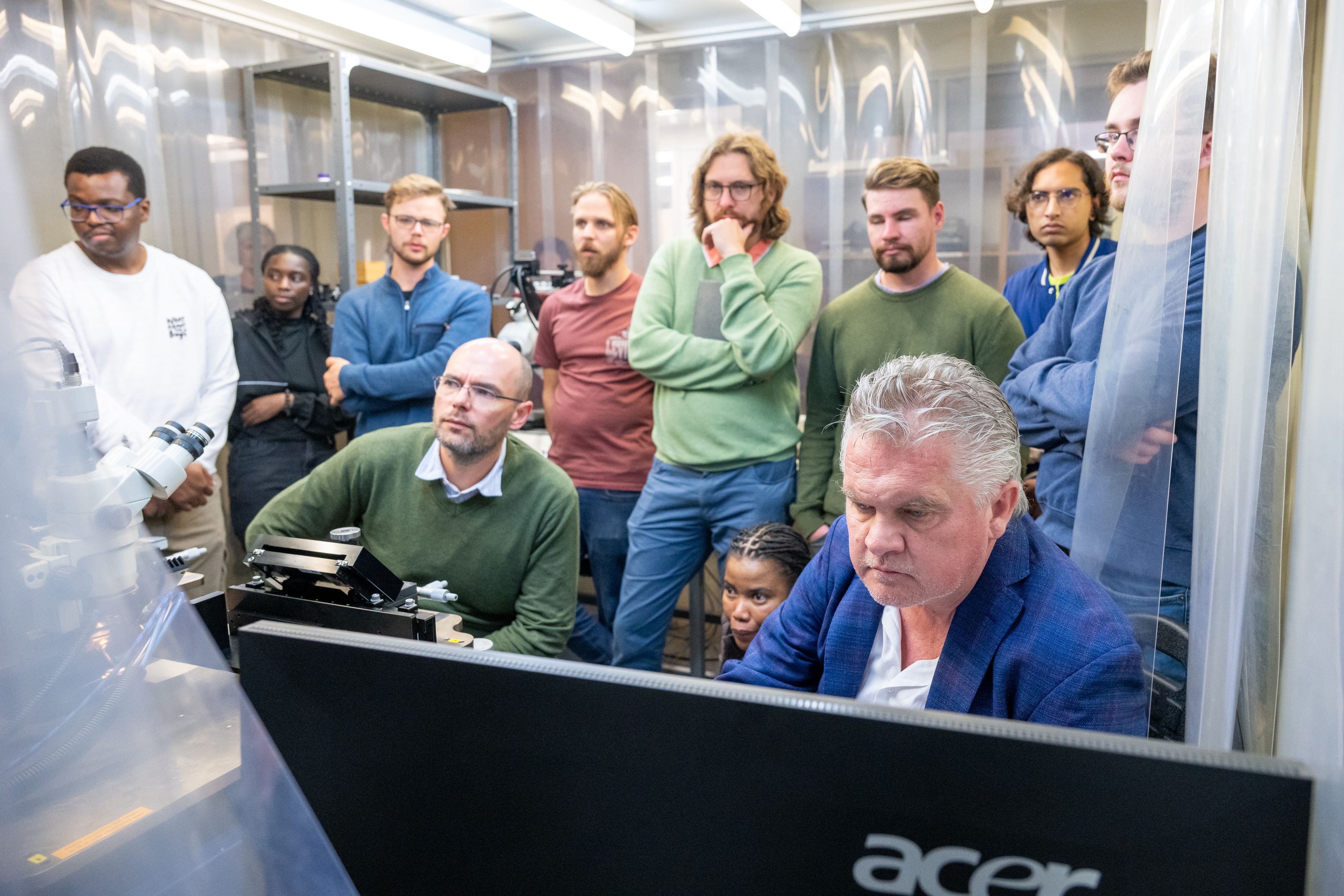
Lead-in training
The
new equipment has been installed in CEFIM’s millimetre (mm)-wave laboratory. It
comprises a new-generation vector network analyser that can provide a
continuous, broadband frequency sweep up to 220 GHz, with matching harmonic
mixers and calibrated noise sources for spectrum and noise analysis.
Postgraduate students and postdoctoral fellows who will be using the equipment in
their research, as well as CEFIM’s staff members who will be supervising
research in this field, and CEFIM’s laboratory technician, Kim Williamson, were
invited to attend lead-in training on the equipment on 26 and 27 May 2026.
It was
presented by Prof Tinus Stander and Dr Heinrich Laue from CEFIM, together with the
instrument suppliers of the different pieces of equipment. This included Darius
Opperman from Tamashi Technology Investments (the South African agent for the
equipment), and Stefano Balzarini (the manufacturer’s representative in the
Europe, Middle East and Africa (EMEA) Region, who is based in Milan, Italy).
Reuben Neate, one of the
postgraduate researchers who attended the training, explains that this
equipment will enable him to perform testing that was not previously possible
in South Africa. His research on
water vapour radiometry at 183 GHz is particularly useful for mm-wave radio
astronomy, specifically to develop systems that can test potential sites for
the next-generation Event Horizon Telescope (ngEHT). This telescope will
capture sharper images and even videos of black holes in the universe by
linking telescopes all over the world together to create a virtual earth-sized
telescope. He is excited to be among the
first researchers to be using CEFIM’s new equipment.
Impact of the new instrumentation
The new instrumentation that has been procured will
enable the full-service electrical characterisation of microwave and mm-wave
devices up to 220 GHz. This was necessary to address the changing scope of
CEFIM’s research field, where terrestrial communications, radiometric imaging
and radio astronomy all require novel electronics research above CEFIM’s
previous limit of 110 GHz.
Even at its previous capacity, CEFIM was the only
South African facility to cover measurements in the frequency range of 70–100
GHz. Extending its capabilities will further enhance the institute’s profile as
a unique, world-class research facility. It will also enable South African
researchers to make an early impact alongside their international counterparts.
Prof Stander, whose work in this field is
internationally recognised, explains that some future 6G communication networks
are expected to operate in the 100–300 GHz bands, whereas many next-generation
radio astronomy receivers are required for observations at sub-THz frequencies.
“As this is an emerging research field, no facility existed in South
Africa to measure electromagnetic waves at this frequency. This is what makes
our establishment of this facility so significant on a national scale.”
The facility has the added
advantage of advancing existing collaborative research projects and enabling
new collaborations, which will impact research across disciplines, and create a
wider impact on the South African innovation system. Its use in
multidisciplinary research projects includes the testing of next-generation
radio astronomy receivers, enabling research outputs shared by astronomy and
electronic engineering. Combined with CEFIM’s existing precision manufacturing
and assembly capabilities, the measurement facility will increase the number of
radio astronomy projects South African engineers can meaningfully participate
in, opening the door to new kinds of sub-THz radio
astronomy research in South Africa.
The facility will also support CEFIM’s development and
fabrication of next-generation radio astronomy receivers at sub-THz
frequencies, funded by a South African Radio Astronomy Observatory (SARAO)
Research Group Grant. It will further support the group’s research
collaborations with the National Autonomous University of Mexico and the
National Institute of Astrophysics, Optics and Electronics (INAOE).
It will also support CEFIM’s
participation in the Atacama Large Aperture Submillimetre Telescope (AtLAST)
project, enabling it to develop prototypes and test selected receiver concepts
in-house. This also applies to its participation in the African Millimetre
Telescope (AMT), led by Radboud University and the University of Namibia, which
will support the ngEHT. CEFIM’s new sub-THz
measurement capabilities and geographic advantage position it perfectly to
become a key technical partner in this project.
Alignment with national priorities
The facility is aligned with
government’s national priorities in terms of testing high-frequency radio
astronomy receivers. Prof Stander observes that, while the National Research
and Development Strategy correctly states that South Africa has “the
engineering capability to build telescopes locally”, the country does not yet
possess the facilities to test the next-generation sub-THz radio astronomy
receivers that would be required for the AMT, the large aperture submillimetre telescope
in the Atacama Desert in Chile or future extensions to the Korean VLBI Network
in South Korea. “This facility will fill that gap in the engineering
capabilities of radio astronomy engineering locally,” he says.
In addition to the design of radio astronomy
receivers, the work done in water vapour radiometry systems for radio astronomy
opacity measurements can also be applied in atmospheric and climate studies.
Other applications of sub-THz technologies include
sub-THz spectroscopy, sensors, radar and imaging (tomography).
The facility’s sub-THz measurement capabilities will further
contribute to CEFIM’s research into the built-in self-testing of high frequency
electronics, which is also funded by the NRF. This research can now be expanded
into sub-THz bands with in-house measurements on both bare wafer dies and
packaged dies.
By continuing to contribute to microelectronics and
electromagnetics research in this frequency range through CEFIM’s activities, the
University of Pretoria is ensuring that South African research remains globally
relevant and competitive, while making an impact locally.
)
)
)
)
)
)
)
)
)
)
)
)
)
)
)
)
)
)
)

)

)
)
)
)
)
)

)
)
)
)
)
)
)

)
)
)
)
)
)
)
)
)
)

)
)
)
)