)
)
)
The University of Pretoria launches Valterra Platinum research chair to advance rock engineering research in SA
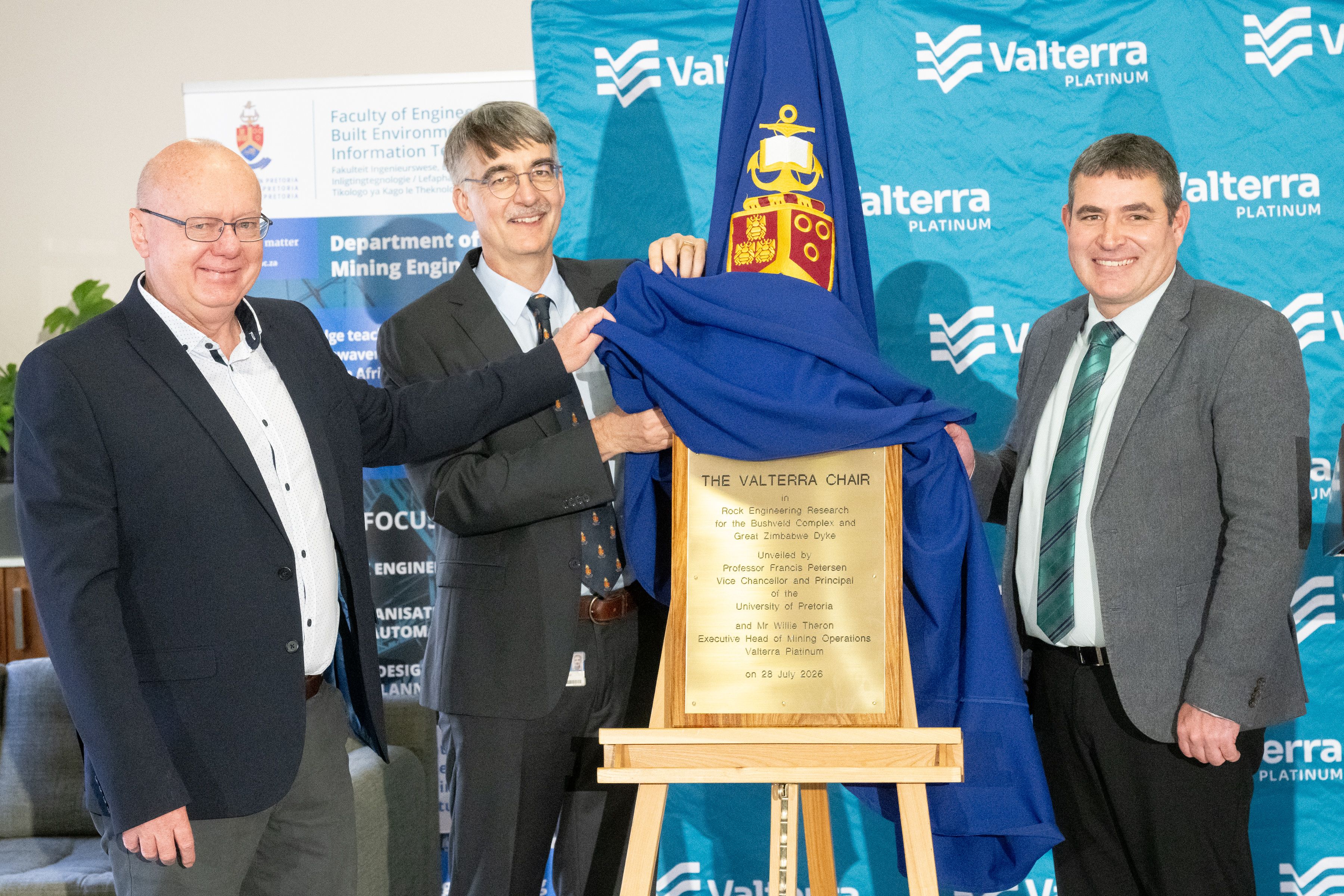
The research chair is expected to become a catalyst
for groundbreaking discoveries, stronger partnerships and lasting impact that
can improve mining safety, support economic growth and contribute to a more
sustainable future in the southern African region. It will provide funding for
an initial period of three years for postgraduate research in the field.
Traditionally, rock engineering
research in South Africa has focused on the country’s gold mines. The layout
challenges of shallow mines in the Bushveld Complex for platinum group metals,
chromium and vanadium have largely been ignored. The research chair will enable
the department’s research activities to be expanded to the Bushveld Complex and
the Great Zimbabwe Dyke to advance the country’s economy.
“This research chair is an important vehicle to enable
fundamental rock engineering research on the layouts and rock types found in
these mines,” said Professor Wynand Steyn, Dean of the EBIT Faculty.
“It demonstrates what’s possible when academia and industry come together
with a common purpose: to generate knowledge that makes a tangible difference.”
Mining has played a defining role in South Africa’s
economic development and continues to be fundamental to the prosperity of the
country and the region. Yet the industry faces increasingly complex technical,
safety and sustainability challenges that demand new thinking, rigorous
scientific enquiry and highly skilled professionals.
“As a leading research-intensive
university, UP is committed to producing knowledge that not only advances
academic excellence, but contributes to solving real-world problems,” Prof
Steyn said. Its vision, he added, is to create a future in which its research
serves society, drives innovation and supports sustainable development across
Africa and beyond.
The establishment of this research chair reflects that
commitment and builds on South Africa’s rich legacy of excellence in rock
engineering research, while helping to strengthen a field that has seen a
decline in research capacity over recent decades. Importantly, it creates an
opportunity to develop new knowledge that will enhance the safety and
productivity of mining operations in the Bushveld Complex and the Great
Zimbabwe Dyke – regions of enormous strategic importance to the global mining
industry.
“Research chairs are not only about advancing science;
they’re about nurturing the next generation of researchers, engineers and
innovators,” Prof Steyn noted.
Through postgraduate education, mentorship and
collaborative research, this initiative will help develop the expertise that South
Africa and Africa need well into the future.
Prof Steyn concluded his address by expressing
appreciation for Valterra Platinum’s confidence in UP and for recognising the
value of long-term investment in research.
“Partnerships such as this demonstrate that industry
and academia can achieve far more together than either can achieve alone.”
In his address, Prof Francois Malan, Head of the
Department of Mining Engineering, provided historical context, emphasising that
early research in mining engineering was identified as an essential need after
the Coalbrook mining disaster at the Clydesdale Colliery in 1960. A large part
of the mine collapsed following the structural disintegration of about 900
underground coal support pillars; 437 miners died.
“Although government support of
mining research has waned since the turn of the century, the mining industry’s problems
have not diminished,” Prof Malan said. “It’s now up to industry to provide the
necessary funding for vital academic research in this area.”
He explained that the proposed
research to be conducted as part of the research chair will focus on critical topics
to improve the productivity and safety of the mines in the Bushveld Complex and
Great Zimbabwe Dyke.
Postgraduate research in this field will be supervised
by internationally recognised rock engineering researchers associated with the
Department of Mining Engineering, such as Prof Malan and Prof John Napier,
whose expertise has been acknowledged by the International Society for Rock
Mechanics. Several master’s and doctoral studies are underway as part of the research
chair. The department encouraged mining engineers engaged in work in the field
– especially those from the sponsoring company and others who deal with
challenges related to mine layouts and pillar design in gold and platinum mines
– to participate in the activities of the research chair. Prof Malan also
welcomed collaboration with UP’s Department of Materials Science and
Metallurgical Engineering.
“At a time when industries are
being reshaped by artificial intelligence and digitalisation, it’s a privilege
for Valterra Platinum to support research in this critical field,” said Willie
Theron, Executive Head: Mining Operations at Valterra Platinum. Theron, a UP alumnus who completed his
master’s research in the Department of Mining Engineering, also shared his
belief that mining remains a critical industry for the country’s future: “The
onus is on us to ensure the continued livelihood of the many communities
affected by mining in South Africa.”
He noted that Valterra Platinum’s
responsibility to produce and market strategic metals has led to its emergence
as a standalone company that supports more than 40 000 livelihoods, directly
and indirectly.
“In alignment with our
purpose of unearthing value to better our world, we believe that, although the
metals we produce are vital for progress, this cannot be to the detriment of
families and communities – which is why we subscribe to the imperative of
zero-harm and encourage research that contributes to this imperative,” Theron said.
Theron recognised that the long-term
success of the industry depends on knowledge, innovation and skills development,
and said he believed the research chair would facilitate the advanced research
that the industry needs. At a time of unprecedented technological advancement
and a drive towards safety in the mining industry, it also provides the
opportunity to cultivate new expertise and create opportunities for future
generations of graduates.
“The prospect of developing new
skills, advancing research and helping to shape meaningful and rewarding
careers in this field is extremely exciting for us, not only as a company, but
as an industry,” Theron said.
He added that the proposed
research topics being considered speak to the challenges of industry and those
that Valterra Platinum faces, from optimised multi-reef extraction strategies
to pillar design research and pillar behaviour.
“We welcome collaboration and the
introduction of new knowledge because, as much as we have an incredible natural
mineral endowment in southern Africa, this is an incredibly competitive global
industry, and we need to ensure the sustainability of the industry.”
Theron said the research chair is
an investment in Valterra Platinum’s long-term sustainability, and an
investment in young people and the country’s economic prosperity.
“We anticipate it strengthening
our talent pipeline, building academic interest in mining, and fostering the
research and innovation required to solve the complex challenges that will benefit
the industry as a whole.”
)
)
)
)
)
)
)
)
)
)
)
)
)
)
)
)
)
)
)

)

)
)
)
)
)
)

)
)
)
)
)
)
)

)
)
)
)
)
)
)
)
)
)

)
)
)
)